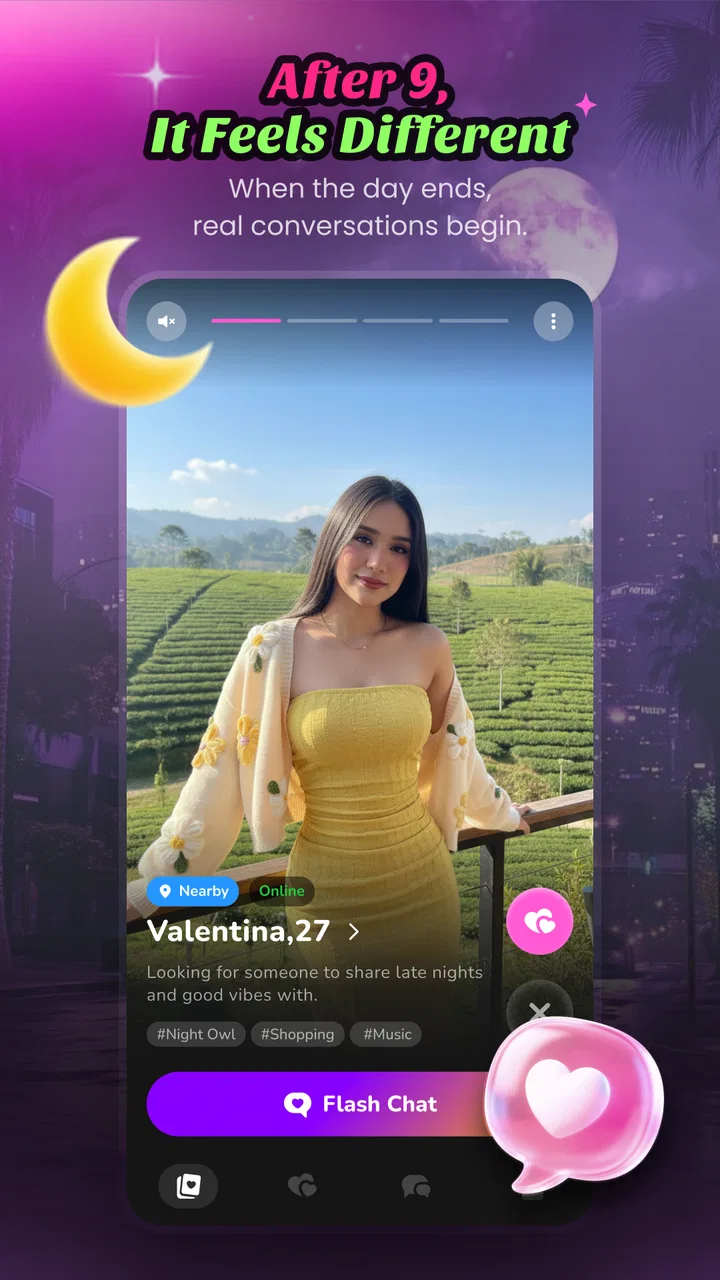
After9-Chat, Flirt, MeetUp
- 4.7
- Rating
- 10.00K
- Installs
- Free
- Price

 Analysis by App-foxy
After9-Chat, Flirt, MeetUp is a social app I would approach with a clear understanding of its intended atmosphere. It is built around conversations and meeting people during later hours, rather than around family organization, public posting, or general-purpose messaging. That makes it interesting for adults who want a more direct social experience, but it also makes household context important. If a phone or tablet is shared, the question is not only whether the app is enjoyable; it is also whether everyone using that device understands its adult purpose.
Developed by EXKLUSIVAPPS, this free app sits in the social category and carries a Mature 17+ age rating. Its store summary points toward real people and late-night conversation, which matches the way I would position it: a place to explore chats, flirting, and possible meetups, not a replacement for a family messenger or a neutral community forum. The current version is 0.0.5, so I would keep expectations realistic and pay attention to how the experience develops over time.
How After9 fits into real household use
When I think about After9 in a shared home, I start with the small, everyday moments: someone borrowing a phone, a screen lighting up on the kitchen counter, or a tablet being left open after a conversation. Those situations make it worth deciding where and when personal social apps belong before they become awkward. A simple household device routine can protect privacy without turning ordinary app use into a source of suspicion.
You May Also Like

 AccuWeather: Weather Radar
AccuWeather Review: A Quick, Clear Forecast for Everyday Decisions
For everyday plans, the best forecast is the one you can understand quickly. AccuWeather makes rain timing, radar, and local conditions easy to act on, with a few trade-offs.

 Hill Climb Racing
Why Hill Climb Racing Still Turns Crashes Into One More Run
A tiny car, a bumpy hill and one more upgrade: Hill Climb Racing keeps resurfacing because its simple chaos makes every near-miss feel personal.

 AliExpress - Shopping App
AliExpress Makes Global Shopping Feel Personal, but Shoppers Bear the Risk
AliExpress turns a global marketplace into a pocket-sized discovery engine. Its reach is useful, its shopping loop compelling, and its trade-offs easy to miss.

 Lords Mobile: Kingdom Wars
Lords Mobile Is a Kingdom-Building Routine, Not a Quick Match
A case-by-case verdict on the building, battles, device demands, and social commitments that make Lords Mobile rewarding for some players and exhausting for others.

 PDF Scanner app - TapScanner
TapScanner Makes Paperwork Easier to Capture, Check, and Share
TapScanner makes scanning with a phone feel less like a rescue operation and more like a dependable step in getting work done. Its capture tools are useful, though not flawless.

 Block Blast!
 Shows How Much a Puzzle Game Can Leave Out
A quiet grid game shows why puzzle players increasingly value instant clarity, repeatable skill and low-pressure play—and where the genre still needs to catch up.
More From Our News Desk
View All News


A shared device changes the decision
Imagine a household where one Android phone is used by several adults, or where a tablet moves between partners, roommates, and older teenagers. In that situation, installing a mature social app can create awkward surprises even when nobody has done anything wrong. A notification, an open conversation, or a visible app icon can reveal more than the device owner intended. For me, this is the first practical issue to solve before exploring the service itself.
I would use After9 on a personal device whenever possible. If that is not practical, I would make the app part of an explicit conversation about who uses the device and when. The app’s late-hours, flirt-oriented identity means it should not be treated like a harmless shared utility. A person looking for a recipe, a child borrowing a phone for a game, or a roommate checking a calendar should not accidentally walk into an adult conversation.
This does not mean the app is unsuitable for every shared home. It means the household needs clear boundaries. I would avoid leaving an active session open, keep the device from being casually passed around while conversations are visible, and close the app after use. Those are simple habits, but they matter more here than they would with a weather app or a standard group chat.
The right use case is personal, not communal
I see the strongest use case as an individual adult checking in during quiet evening time, starting conversations, and deciding whether a new contact feels worth continuing with. The app’s focus is narrower than a broad social network, and that can be refreshing if you do not want an endless feed of unrelated posts. Instead of opening it to manage a household, I would open it for a personal social goal.
A realistic scenario would be an adult finishing work, wanting conversation without involving colleagues or family groups, and browsing the app for a more relaxed exchange. They might chat for a while, decide that the person is not a good match, or arrange a public meetup later. The value is in that focused transition from online conversation to possible real-world contact. The trade-off is that the user must make more careful judgments because the social purpose is personal and potentially intimate.
For household coordination, I would choose a conventional messenger, shared calendar, or notes app instead. Those tools are clearer for shopping lists, school pickups, bills, and travel plans. After9 is not where I would expect to organize chores or make sure everyone knows who is collecting the keys. Using it for that would be like using a dating-oriented space as a family noticeboard: possible in theory, but badly matched to the task.
Setup should begin with boundaries
My first step would be deciding what I am actually looking for before creating momentum in conversations. Am I interested in casual chat, flirting, meeting someone, or simply seeing how the community feels? That decision helps prevent vague exchanges that become uncomfortable later. It also gives me a better way to communicate honestly with another person.
I would keep the first profile and opening messages restrained. A late-night social environment can encourage quick familiarity, but speed is not the same as trust. I would avoid sharing a home address, work location, private routines, or details that make it easy to identify where I live. If a conversation becomes personal, I would reveal information gradually and only when the other person has shown consistent respect.
One useful workflow is to separate curiosity from commitment. I can explore a conversation without agreeing to a meetup, and I can consider a meetup without treating it as a relationship. That sounds obvious, yet it is an important distinction in an app centered on chatting, flirting, and meeting. Keeping those stages separate makes it easier to leave a conversation that feels rushed or manipulative.
Coordination matters before any meetup
If I decided to meet someone I first encountered through After9, I would treat the meetup as a separate safety decision rather than the natural final step of a chat. I would choose a busy public place, arrange my own transportation, and tell a trusted person where I am going. I would also set a check-in time that does not depend on the new contact.
There is a household angle here too. If I live with a partner, family member, or roommate, I would be clear about whether the meeting is private, social, or part of an agreed relationship arrangement. The app cannot resolve those conversations for me. A tool that makes it easier to meet people can also expose unclear expectations at home, so honesty outside the app is just as important as good judgment inside it.
I would not use a shared household calendar to broadcast intimate details, but I would make sure one trusted person knows enough to help if plans change. That balance protects privacy without turning a meetup into an isolated event. It is a small but meaningful distinction between keeping something personal and keeping it secret from everyone.
Another practical tip is to avoid making plans while tired, lonely, or under pressure. The late-hours concept may be appealing precisely because people are more available at night, but late-night decisions can also be impulsive. I would read the conversation again the next day before confirming a location or sharing contact details. If the plan still feels comfortable in daylight, it is more likely to be a considered choice.
Age context is part of the experience
The Mature 17+ rating should be taken seriously. I would not install this app for a younger child, let a child browse it out of curiosity, or assume that a shared family device makes it appropriate for everyone. The adult tone is not a minor detail; it shapes the kind of conversations a user may encounter and the boundaries they need to maintain.
For homes with teenagers, I would choose a different approach: explain that this is an adult social app and keep it separate from youth-oriented communication. I would not rely on the app itself to create household rules. The useful boundary is a household decision about devices, accounts, and privacy, not an assumption that an app can manage age context on its own.
For adults sharing a device, separate user habits are equally important. I would sign out when appropriate, avoid saving private conversations where another person can casually read them, and never assume that a partner or roommate wants to see flirtatious content. Privacy is not automatically suspicious; it is a normal part of personal communication. At the same time, privacy should not be used to conceal behavior that violates an existing relationship agreement.
Trust is more important than a polished conversation
The social setting may make people seem available and approachable, but a friendly exchange is not proof of identity, intention, or reliability. I would watch for pressure to move immediately to another channel, requests for money, dramatic emergencies, or attempts to make me feel guilty for asking reasonable questions. Those are not signs that a conversation is becoming meaningful; they are reasons to slow down.
I would also be cautious with photos and personal details. A picture can help someone decide whether to continue chatting, but it does not establish that a person is genuine or safe. I would avoid sending anything that could cause lasting problems if it were copied or shared. This is especially important on a shared device, where private media may remain visible through ordinary browsing habits even after a conversation ends.
A concrete trust test is to set a modest boundary and observe the response. If I say I am not ready to meet, or that I prefer a public location, a respectful person should accept that without turning the conversation into an argument. If the response is anger, ridicule, or relentless persuasion, I would stop engaging. The test is useful because it evaluates behavior rather than relying on charm.
What the app does better than ordinary alternatives
Compared with a general social network, After9 has a more defined purpose. A broad platform can bury personal conversations under entertainment, news, family updates, and promotional content. Here, I would expect the experience to feel more directly connected to talking, flirting, and possible meetups. That focus can save time for an adult who knows what kind of interaction they want.
Compared with a normal messaging app, it also offers a discovery-oriented starting point. A messenger is excellent once I already know whom I want to contact, but it does not usually help me enter a new social context. After9 is more useful at that earlier stage, when I am open to meeting people rather than simply coordinating with existing contacts.
However, a focused social app is not automatically better. If I want a large range of communities, detailed public discussion, or a long-established contact list, a mainstream social network may be more suitable. If I want private conversations with people I already trust, a standard messenger is the better choice. After9 makes the most sense when its specific social purpose matches my intention.
Where the early version requires patience
The current version is 0.0.5, and that signals an early product stage to me. I would be willing to encounter rough edges, a smaller-feeling community, or parts of the interface that still need refinement. That is not a criticism of the concept, but it changes how I would evaluate it. I would try it without assuming that every workflow has reached its final form.
The app has an average rating of 4.6 from around 1.3 thousand ratings, which suggests that many early users have responded positively. I would treat that as encouraging rather than conclusive. A rating can tell me that the general direction works for people, but it cannot decide whether the tone, pace, or available conversations suit my particular expectations.
It has passed the ten-thousand-install mark, so it is not merely a private experiment with no audience at all. Even so, the scale is modest compared with the biggest social platforms. That can be an advantage if I prefer a less overwhelming environment, but it may be a drawback if I expect a constant stream of compatible conversations in every place and time zone.
Costs and expectations before spending
After9 is free to install, with optional in-app purchases ranging from $1.99 to $39.99 per item. I would use the free experience first and decide whether the app genuinely improves my conversations before paying for anything. The most important question is not whether a purchase sounds attractive; it is whether it solves a problem I actually have.
I would be particularly careful with spending in a social app because the emotional context can influence decisions. If I am excited by a new contact or frustrated by slow progress, I might be tempted to pay simply to change the situation. My rule would be to wait, compare the benefit with my original goal, and set a personal limit before buying. A paid option should provide clear convenience, not become a response to pressure or disappointment.
People who dislike optional purchases in social apps may prefer a service with a simpler cost structure. On the other hand, someone who wants to test the experience without paying upfront may appreciate the free entry point. The right choice depends on whether I can enjoy the core social purpose without feeling pushed toward extras.
Who I would recommend it to
I would recommend After9 to an adult who wants a focused space for evening conversation, is comfortable with a mature social atmosphere, and can maintain firm boundaries. It suits someone willing to move slowly, distinguish chatting from meeting, and accept that not every conversation will become meaningful. It may also appeal to a person who finds general social networks too noisy and ordinary messengers too limited for meeting new people.
I would skip it for anyone seeking household coordination, child-friendly communication, or a neutral community platform. I would also suggest another option to a person who wants extensive privacy controls, a large established network, or a purely anonymous browsing experience. The app’s appeal depends on being open to direct social interaction, and that is not what every user wants.
For couples or roommates, I would recommend discussing expectations before installing it on a shared device. Some households may be comfortable with independent social use; others may consider flirtatious conversations a relationship issue. The app itself cannot define that line. The better choice is the one that fits the agreements between the people who share the home.
My household verdict
After using the app as a social tool rather than treating it like a general messenger, I see a clear but specific appeal. It gives adults a focused route into late-hour conversations, flirting, and possible meetups, while its free entry point makes initial exploration easy. The strong early rating and growing install base make it worth a look for the right audience, especially someone who wants something more targeted than a broad social feed.
My main reservation is not the idea of the app; it is the responsibility that comes with the idea. Shared-device privacy, mature content, relationship expectations, and meetup safety all need attention before the experience becomes comfortable. The early version also means I would give it room to improve instead of judging it as a finished, fully established platform.
My recommendation is simple: use it as a personal adult social space, not as a household communication tool. Keep accounts and conversations separate, take the 17+ context seriously, slow down before meeting anyone, and try the free experience before considering an in-app purchase. With those boundaries in place, it can be a worthwhile option for late-evening connection. Without them, a conventional messenger or a broader social platform will probably be the safer and more practical fit.
In short, I would recommend After9-Chat, Flirt, MeetUp to a careful adult looking for focused social discovery, while advising shared households to establish clear device and relationship boundaries first. Its best quality is its direct purpose; its biggest limitation is that direct purpose demands more judgment from the person using it.
FAQs for After9-Chat, Flirt, MeetUp
01What is After9-Chat, Flirt, MeetUp, and who is it designed for?
After9-Chat, Flirt, MeetUp is a social and dating-oriented app designed to help adults start conversations, discover people with similar interests, and arrange casual meetups. From the features available, it appears focused on chatting and making new connections rather than replacing a full relationship platform. Before downloading, users should review the app’s age requirements, supported regions, and community guidelines to confirm that it suits their expectations.
02Is After9-Chat, Flirt, MeetUp free to download and use?
The app may be available to download without an upfront charge, but some features can require in-app purchases, a subscription, or virtual credits. These paid options may include enhanced visibility, additional messaging tools, or access to selected profiles and functions. Check the current store listing and the payment screen carefully before confirming anything, especially renewal terms, trial periods, and cancellation instructions.
03Is After9-Chat, Flirt, MeetUp safe for meeting people online?
No dating or chat app can guarantee that every profile is genuine or that every conversation will be safe. Users should avoid sharing passwords, financial information, home addresses, or private documents, and should be cautious of anyone requesting money or pressuring them to move conversations elsewhere. If arranging a meeting, choose a busy public location, tell someone you trust, and use the app’s reporting or blocking tools when necessary.
04Can users control who contacts them on After9-Chat, Flirt, MeetUp?
The available privacy and communication controls may allow users to manage conversations, block unwanted contacts, or report suspicious behavior, although the exact options can vary by app version and device. Before becoming active, explore the profile, notification, and privacy settings. It is also worth checking whether your profile can be hidden, whether location information is displayed, and how easily unwanted messages can be restricted.
05What information does After9-Chat, Flirt, MeetUp collect?
A social and dating app may request information such as an email address, phone number, profile details, photos, approximate location, device data, and activity information. The exact collection practices depend on the current privacy policy and permissions requested during installation. Review those documents before creating an account, grant only permissions that seem necessary, and consider using a profile that reveals personal information gradually rather than publicly.
Pros
- Quick sign-up makes it easy to start meeting people.
- Chat and flirting features are organized in a simple interface.
- Useful for finding nearby users with similar dating interests.
- Profile browsing helps you decide whom to contact first.
- The app can make casual social connections feel more approachable.
Cons
- The quality of matches may vary depending on your location.
- Some features may require a paid subscription or in-app purchases.
- New users might encounter incomplete or lightly detailed profiles.
- Chat activity can be inconsistent outside busy hours.
- Privacy settings should be reviewed carefully before sharing personal details.

After9-Chat, Flirt, MeetUp
Gallery